Promotion Prep Gets You Ready for the Test. Fire Forged Command Gets You Ready for the Room
May 26, 2026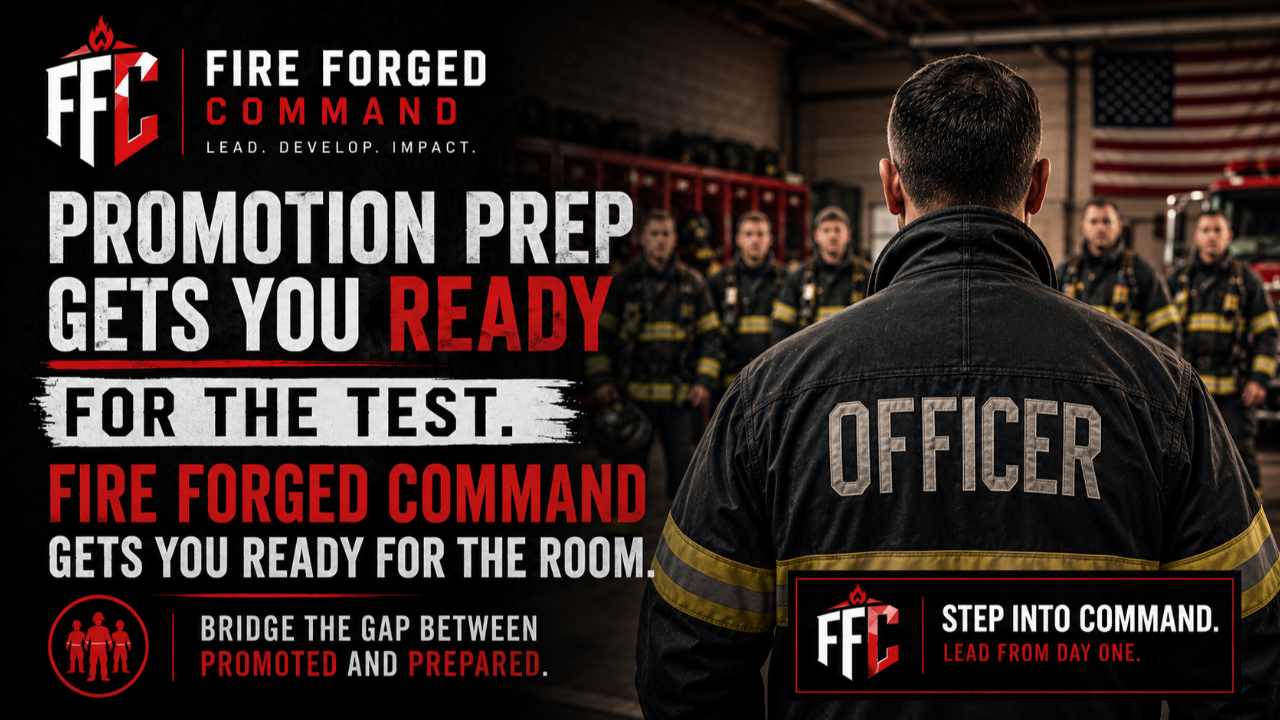
Getting promoted is not the finish line.
It is the beginning of a different test.
For a lot of firefighters, the promotional process becomes the target. They study the books. They prepare for the assessment center. They practice the interview. They learn policies, procedures, incident priorities, building construction, fire behavior, department rules, and whatever else the process requires.
That work matters.
Promotion prep has value.
But promotion prep is not the same as officer development.
Passing the test may put the bugle on your collar. It does not automatically prepare you to lead the room.
That is where the real work begins.
The Test and the Room Are Not the Same Thing
The promotional process usually measures whether a firefighter can study, answer questions, communicate under pressure, and demonstrate enough knowledge to be considered for the next rank.
That is important.
But the room measures something different.
The room measures your consistency.
The room measures your credibility.
The room measures how you handle conflict, correction, expectations, pressure, frustration, laziness, informal influence, former friendships, and daily standards when no chief is watching.
The test asks what you know.
The room watches what you allow.
The test asks how you would answer.
The room watches how you actually act.
The test gives you a score.
The room gives you credibility or takes it away one decision at a time.
That is the gap too many new officers walk into. They prepared for the process, but they were never fully prepared for the responsibility that came after it.
Promotion Changes the Room Before It Changes You
One of the hardest parts of becoming a company officer is that the room changes immediately, even if you do not feel different yet.
Yesterday, you were one of the firefighters.
Today, you may be responsible for the same people you worked beside, joked with, complained with, trained with, and trusted.
That transition is not simple.
You do not become better than them.
You do not become disconnected from them.
You do not have to become cold, distant, or arrogant.
But something did change.
The responsibility changed.
The expectations changed.
The consequences changed.
The crew may still know the old version of you, but the role now requires a different level of discipline. You cannot lead well if you are still trying to protect every old comfort. Friendship cannot outrank the standard. Popularity cannot outrank readiness. Avoiding a hard conversation cannot outrank the responsibility of the seat.
Promotion gives you the position.
Consistency earns you the room.
The First Mistake: Thinking Authority Is Enough
Some new officers walk in believing the bugle will do the work for them.
It will not.
Rank can give direction. It can assign work. It can enforce policy. It can create formal authority.
But rank alone does not create trust.
It does not create buy-in.
It does not create culture.
It does not make people believe in your judgment.
A crew may follow an order because they have to. That is not the same as trusting the officer giving it. A crew may stay quiet because they are being professional. That is not the same as respect. A crew may not push back in front of you. That does not mean they have bought in.
New officers have to understand this early.
The bugle may change what people call you, but your habits will decide what they believe about you.
The Second Mistake: Trying to Stay One of the Guys
The opposite mistake is just as dangerous.
Some new officers are so afraid of losing relationships that they avoid leading at all.
They let small things slide.
They avoid correction.
They delay expectations.
They laugh off problems they know should be addressed.
They tell themselves they are building trust, but what they are really doing is avoiding discomfort.
That kind of leadership feels easier early, but it gets expensive later.
Because what you allow becomes the standard.
The missed checkoff becomes normal.
The lazy drill becomes normal.
The late assignment becomes normal.
The bad attitude becomes normal.
The informal leader with the strongest personality begins shaping the room while the officer tries to stay liked.
By the time the officer finally decides to act, the crew has already learned what matters and what does not.
Not because of what the officer said.
Because of what the officer tolerated.
Officer Development Has to Go Beyond the Fireground
The fireground matters. Tactics matter. Size-up matters. Command presence matters. Decision-making under pressure matters.
But many of the decisions that define a company officer happen away from the fireground.
They happen in the station.
They happen during training.
They happen during the first missed expectation.
They happen when a former peer tests the line.
They happen when the crew is tired, frustrated, bored, complacent, or divided.
They happen when the officer has to decide whether to correct something small now or hope it fixes itself later.
They happen in the daily rhythm of the company.
That is where credibility is built.
That is also where credibility gets damaged.
A firefighter can be technically strong and still struggle as an officer if they have never been taught how to lead people, set expectations, communicate standards, manage conflict, build trust, develop the crew, and create consistency inside the room.
The fire service does not just need people who can pass promotional processes.
It needs officers who are prepared to lead after the process is over.
The Gap Between Promoted and Prepared
This is the gap Fire Forged Command was built to address.
The gap is not that firefighters are not capable.
The gap is not that promotional preparation is useless.
The gap is that getting someone ready for the test is not the same as getting someone ready for the room.
A firefighter may know the policy and still struggle to hold people accountable.
A firefighter may know the tactical worksheet and still avoid a hard conversation.
A firefighter may be respected in the backseat and still lose credibility in the front seat.
A firefighter may have years of experience and still be unprepared for the identity shift that comes with being responsible for the crew.
That does not mean they are weak.
It means they need development.
Practical development.
Realistic development.
Fire-service-specific development.
The kind of development that teaches firefighters what happens after the test, after the interview, after the list, after the badge, and after the first shift in the seat.
The Room Tests What the Process Cannot
The room tests whether you can be steady.
It tests whether your words match your actions.
It tests whether you can lead former peers without pretending nothing changed.
It tests whether you can correct small things before they become culture.
It tests whether you can read the crew before trying to move the crew.
It tests whether you can choose trust over popularity.
It tests whether you can hold a standard without making everything personal.
It tests whether you can take responsibility for the environment around you.
That kind of leadership is not built by accident.
It has to be developed.
What Fire Forged Command Means by Officer Readiness
Officer readiness is not just knowing enough to promote.
Officer readiness means being prepared to carry the responsibility that comes after promotion.
It means understanding that your crew is studying your consistency from day one.
It means knowing that quiet does not always mean respect.
It means recognizing that every room has informal leaders, habits, loyalties, frustrations, strengths, and weak spots before you arrive.
It means learning to watch first and move second.
It means setting expectations before emotions force the conversation.
It means understanding that trust matters more than popularity.
It means accepting that the standard starts with you.
That is the work.
That is the transition.
That is what it means to move from promoted to prepared.
First Due Essentials Was Built for This Gap
Fire Forged: First Due Essentials was built for firefighters and new officers who understand that the test is not enough.
It is for the firefighter preparing for promotion who wants to be ready before the bugle lands on their chest.
It is for the new company officer who got promoted and quickly realized the room is more complicated than the process made it seem.
It is for the officer who wants a practical system for leading people, setting expectations, building trust, correcting small issues, handling conflict, and creating credibility one shift at a time.
This is not theory for the sake of theory.
This is not generic leadership language copied and pasted into a fire service setting.
This is practical officer development for the firehouse.
Because the firehouse is where most officers either build credibility or lose it.
Promotion Is the Start. Preparation Is the Work.
If you are preparing for promotion, keep studying.
Know your job.
Know your policies.
Know your tactics.
Prepare for the process.
But do not confuse passing the process with being fully prepared to lead.
The real test starts when the room is watching.
When the first standard slips.
When the first former peer pushes the line.
When the first uncomfortable conversation shows up.
When the crew wants to know whether you are steady or just wearing a new title.
Promotion prep gets you ready for the test.
Fire Forged Command gets you ready for the room.
Step Into Command
Before the room tests you, test your readiness.
Start with the free Officer Readiness Assessment and identify the leadership gaps that could hurt your credibility before the room finds them for you.
Take the Free Officer Readiness Assessment:
Take the Free Officer Readiness Assessment
First Due Essentials early access is coming soon.
Built for the gap between promoted and prepared.